UNDERSTANDING YOUR PROPERTY TAXES
In Illinois, property taxes are the most localized form of taxation, specifically within the confines of Wayne County. These taxes directly support essential local entities such as school districts, libraries, county government, villages, townships, and more. The allocation of property tax funds is determined at the district level, overseen by locally elected boards.
In essence, you have a direct voice in this process! Active participation is crucial to guarantee that your tax dollars are utilized efficiently by the respective districts and their representatives. To further illustrate the property tax cycle, refer to the accompanying Property Tax Cycle Chart below. This visual aid provides an insightful overview of the cyclical progression of property taxes within our community.
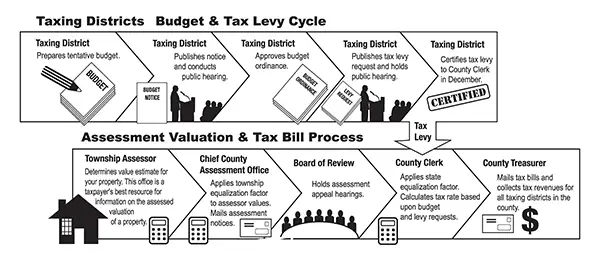
There are two major components of the tax system: Valuation and Taxation
Valuation: The assessment office establishes the full market value of the properties in the township. The assessment is one-third of full market value per Illinois Statutes.
Taxation: Taxes are the result of the monies needed to operate each unit of government shown on your tax bill (county, cities, township, school districts, fire protection districts, library districts, etc.). These units of government levy their needed monies by certification to the County Clerk toward the end of each calendar year. These levy amounts are converted to a tax rate based on the amount of taxable assessed value within the respective taxing district.
Tax Rate Formula: The levy is extended into a tax rate by the following formula:
(Equalized Assessed Value – Exemptions) x Tax Rate = Tax Bill
Levy amount divided by Taxable Equalized Assessed Value = Tax Rate
People accepted increasing property values and taxes when the market was good. As the real estate market shows a decrease it would be logical to think taxes would decrease as well. This is not necessarily true. The taxes will not decrease until the levy amounts decrease as well. It is true that an assessment reduction does not necessarily equate to a reduction of the real estate taxes unless the respective units of government reduce the amount of monies needed to operate.
What Should I Do If There Is An Error On My Tax Bill?
It is typically too late to make an adjustment once the tax bill is received. There are a few exceptions, all of which should be addressed with the Supervisor of Assessments Office at 618-842-2582. If there are missing exemptions, please contact the Assessment Office to determine if you qualify. If there is an error in FACT about the property it is possible for an adjustment to be made.
What If I Object To My Tax Bill?
If you are still dissatisfied with your tax bill after communication with the Assessment Office and the Wayne County Board of Review, you are required to submit payment for the taxes. Simultaneously, you must file a tax objection complaint with the Wayne County Circuit Clerk, commonly referred to as a “payment under protest.” An essential part of this process involves appearing in court to state your objection to the billed amount. It’s important to note that the payment under protest is a legal procedure distinct from the Treasurer’s Office, and the tax bill must still be settled by the designated due dates to avoid late penalties.
What Happens If I Do Not Pay My Property Taxes?
In Illinois, taxpayers are still responsible for the tax even if a bill is not received. In (35ILCS 200/20-15): “The failure or neglect of the collector to mail the bill, or the failure of the taxpayer to receive the bill, shall not affect the validity of any tax, or the liability for the payment of any tax.”
There are several steps that are taken to collect unpaid property taxes:
- The taxpayer is mailed a certified letter notifying them of delinquency and the next steps.
- The unpaid parcel information is published in a local newspaper.
- If still unpaid after a period of time, taxes are put up for sale at the annual tax sale. This is the annual auction of delinquent taxes to tax buyers. The tax sale does not auction off the actual property. At this auction, tax buyers bid on an interest rate (between 0-9%) and upaid property taxes. If a buyer wins the auction, they will be responsible for paying the taxes that year. If the property owner redeems the taxes, the buyer will be paid back the amount of the taxes paid plus the interest bid. If the property owner does not redeem the taxes by the next tax cycle, the tax buyer has the opportunity to buy subsequent year taxes. After 30 months without the back taxes being redeemed by the property owner, the tax buyer can ask the court for a tax deed to the property, at which point the tax buyer becomes the legal owner.
- If a tax buyer doesn’t buy the taxes at the annual tax sale, the property goes to the Wayne County Trustee, an agent of Wayne County. After 30 months of being unpaid, the Wayne County Trustee will take possession of the deed and property and are entered into the Sealed Bid Auction. Buyers submit a minimum bid and the property is sold at the highest bid. The buyer is not responsible for back taxes on the property. The Sealed Bid Auction is held once per year. Catalogs for the auction are available approximately 309 days prior to the auction and can be viewed online at by clicking here to visit the Illinois Tax Deeds/ Illinois Tax Liens website or in the Treasurer’s Office.
Within Wayne County, key individuals play pivotal roles in the realm of property taxes, each specializing in distinct aspects to ensure transparency and ease for residents.
Yvette Anderson, the Wayne County Treasurer/Collector, can be reached at 618-842-5087. She bears the responsibility of tax collection and is the custodian of funds amassed for the various taxing agencies.
For comprehensive details on tax rates, taxing district levies, and delinquent taxes, turn to Liz Ann Woodrow, the Wayne County Clerk. You can contact her at 618-842-5182.
If you need insights into how your assessment was determined, assistance with property descriptions, or need to address changes in name and address for billing, connect with Jodi Poole, the Wayne County Supervisor of Assessments, at 618-842-2582. Additionally, the assessment office is your go-to source for information on exemptions such as Owner Occupied, Senior Citizens, Senior Citizens Assessment Freeze, Home Improvement, Disabled Persons, Disabled Veterans, Returning Veterans, or any other applicable exemption.